










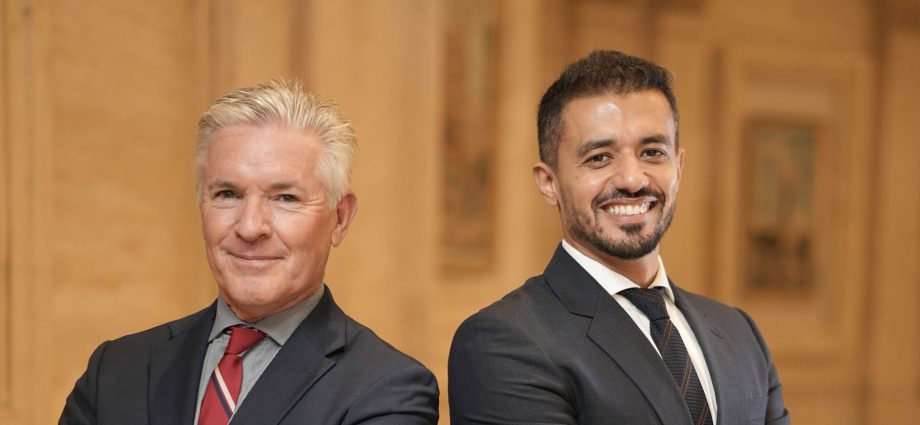
AVEVA’s Khaled Salah and Glenn Kerkhoff argue that the next phase of industrial digitalisation depends on trusted data foundations, practical use cases and a deliberate path from local success to enterprise adoption.
BY COLLEN GEZA | EDITOR, AFRICA MINING & CONSTRUCTION MAGAZINE
“The next level of transformation in Africa is to take those successful use cases to scale.” — Khaled Salah
Across African mining and industry, digital pilots are becoming easier to find. The harder task is making successful ones work beyond a single machine, production line or site. That is the next stage of transformation, says Khaled Salah, AVEVA’s Vice President for Africa: moving from proof of concept to solutions that can be scaled across operations.
Salah describes this as a change in both focus and proximity. In 2025, AVEVA split its former Middle East and Africa remit into separate markets, with Salah leading the Africa business from January 2026. The decision, he says, reflects the continent’s potential and the need to work more closely with customers and partners. AVEVA’s primary focus in Africa is on process industries, including oil and gas, metals and mining, and power; other sectors are served through its partner ecosystem.
He sees Egypt as a hub for North and West Africa and South Africa as a hub for the south and east, citing the maturity of those markets and the appetite he encounters among executives to adopt digital technology. But appetite alone does not create transformation. Salah says pilots are widespread, while large-scale deployment remains the bigger opportunity.
His prescription is “Africa for Africa”: build around the conditions and needs of each customer rather than transplanting a template from Europe or the United States. That means understanding the operation, developing local capability through partners and starting with a defined use case. Salah says a focused pilot can help customers assess value quickly, then expand if the results justify it. AVEVA’s engineering, operations and CONNECT capabilities, he adds, are designed to support that progression across the asset lifecycle.
For Glenn Kerkhoff, AVEVA’s Global Industry Principal, MMM, the same discipline applies to digital twins. A digital twin is not a single product, he says, but a working representation of physical assets built from connected data and a range of technologies. In a mine, that data may come from fixed plant as well as mobile equipment such as trucks, shovels and drills.
Collecting data is only the beginning. It must be brought together, harmonised and given context so that teams can use it to improve maintenance, operations or product quality. Kerkhoff notes that disconnected systems and information silos are challenges for mining companies around the world, not just in Africa. Once the data is usable, analytics, artificial intelligence and simulation can help teams identify patterns, support decisions and test scenarios.
The sequence matters. Kerkhoff recommends building digital-twin capability in phases: perhaps starting with a fixed plant, then extending to mobile equipment; addressing maintenance before productivity, for example. Each phase should deliver value and provide a foundation for the next. The aim is a capability that matures over time, rather than a large programme whose benefits are delayed until everything is connected.
That foundation also affects the pace of automation. Kerkhoff says some of the world’s largest miners have advanced autonomous operations, but readiness differs by region and company. Autonomous equipment requires supporting infrastructure and significant investment, so the business case must be clear. African operations are earlier on the digital-maturity curve, in his assessment; reliable, secure data platforms will be important to support more advanced automation and demonstrate its return.
Sustainability, in Salah’s framing, is closely linked to operational performance. He points to energy management and the need to “do more with less”. Better industrial data can give a mine visibility from an individual asset, such as a truck, through to an enterprise view of operations. That visibility can inform decisions about productivity and energy use.
Black Rock Mine Operations (BRMO) – Africa
Black Rock Mine Operations (BRMO) South African mining company leverages AVEVA software to centralise operations, consolidate its value chain, and increase situational awareness among three individual mine shafts. BRMO’s new system is powered by a suite of AVEVA solutions, including System Platform with Historian and OMI visualisation for the video wall.
With its current AVEVA solution in place, BRMO has improved data quality significantly, with some sources improving more than five-fold. Establishing the Central Control Room was also instrumental in BRMO’s change process by improving in-shift reporting from less than 50% to a sustained 90%. Additionally, BRMO has seen a significant increase in uptime, improvement in safety, and nearly double-digit growth in overall productivity – but it appears to have only scratched the surface of its digital transformation. As new challenges arise, BRMO won’t hesitate to address them with AVEVA. Because of the visualisation technology and the software its deployed thus far, BRMO’s cost for expansion moving forward will be low and implementation will be hassle-free.
For construction and capital projects, Salah focused on connecting engineering information with operations. He described CONNECT as a shared platform through which information can be brought together, analysed and exchanged with partners, with deployment options spanning cloud, on-premises and hybrid environments. That points to a broader lifecycle goal: preserving useful engineering information as a project moves into operation. Lonmin Mining Company improved operational efficiency by 10% and saved R300 million by eliminating technology silos and centralizing operations and data management with AVEVA software solutions. Management can now meet the needs of the mine by maximizing production and scaling its workforce.
People and adoption complete the picture. Salah says AVEVA is working with universities like SUTech Elsewedy University of Technology in Egypt to build digital skills. Discussions are also ongoing with universities in Nigeria and South Africa to form similar partnerships.. He expects larger African companies to move from machine- or production-line deployments towards enterprise adoption over the coming years.
Kerkhoff likewise describes digital transformation as a journey: customers need to prioritise valuable use cases, phase investment and build foundations that can support more analytical and automated operations later.
The message from both executives is practical. Africa’s next industrial-data gains will depend on choosing the right problems, preparing the data and people, and scaling what delivers value. For customers, the first step is to define the operational decision they want to improve, establish a sound data foundation and make each stage earn the next.
