









How sub-micron wear particles are shortening equipment life across industrial operations, and why conventional cleanliness standards may not be addressing them
Sub-micron contamination is not a mining-only challenge. It can affect any operation where lubricated, hydraulic or process equipment must operate reliably. LPR Group supports customers across machinery and manufacturing, power generation, food and beverage, chemical processing, engineered wood press, pulp and paper, mining, renewable energy and wind, sugar processing, and on-road and off-road fleet operations. Across these industries, equipment reliability directly affects productivity, operating costs and asset life. Whether the application is a haul truck, production line, turbine, hydraulic system, process plant or heavy-duty fleet, contamination can become an invisible source of wear. The principles discussed here therefore apply well beyond mining.
Most contamination-control strategies focus on what can be measured. ISO cleanliness codes, PQ Index readings and routine oil analysis are standard tools. They are useful, but can share a critical blind zone.
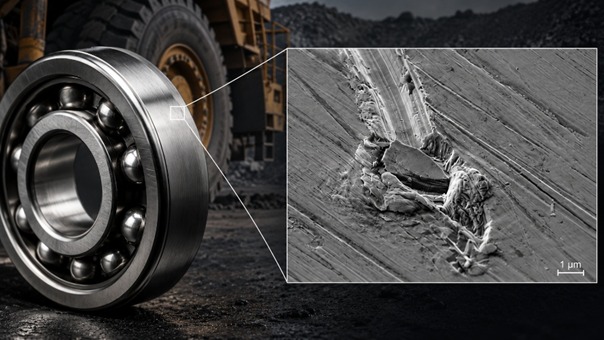
The most wear-active contamination operates below 4 microns, with the sub-micron fraction, below 1 micron, being the most damaging. These particles enter the oil film directly, operate inside the contact zone between moving surfaces, and initiate surface fatigue from the first operating hour.
And they are invisible to every cleanliness standard the mining industry currently uses.
ISO 4406’s lowest reporting channel begins at 4 microns. That threshold was introduced in the 1999 revision around the capabilities of automatic particle-counting technology, not because 4 microns represents a tribological boundary. The current 2021 edition retains the same lower reporting channel.
The PQ Index has a different limitation. Its response scales with particle volume, making very small ferrous particles increasingly difficult to detect. A system meeting ISO 18/16/13 can therefore still contain tens of millions of sub-4-micron particles per milliliter, a population the standard does not report.
A system meeting ISO 18/16/13 can therefore still contain millions of sub-4-micron particles per milliliter, a population the standard does not report.
Conventional filtration can compound [EV1] [MV2] the problem. Filter elements are rated under controlled laboratory conditions using standardized test dust at constant flow, conditions that differ significantly from field operation. In service, hard iron, steel, and silica wear particles cut through filter media and create wormholing, while pressure surges and changing flow open preferential paths through the element. These effects reduce real-world capture efficiency below the laboratory rating. Larger particles are more readily captured, but finer contamination continues circulating. Sub-micron particles are especially damaging because they are small enough to enter the lubricating film and contact zone directly, where they initiate surface wear from the earliest stages of operation.
A Different Principle
One Eye Industries developed its Magnetic Filter Element to operate in exactly this range. Rather than sorting contamination by particle size, it sorts by magnetic susceptibility.
The OEI Magnetic Filter Element captures ferrous and non-ferrous wear particles, including iron, steel and silica, down to and below 1 micron, with 99%+ efficiency, without flow restriction, and with a service life rated at 25 or more years. The technology is deployed across more than 40 countries in mining, oil and gas, power generation, manufacturing and processing, protecting rotating equipment, hydraulic circuits, lube oil systems and process fluids.
What It Looks Like in Practice
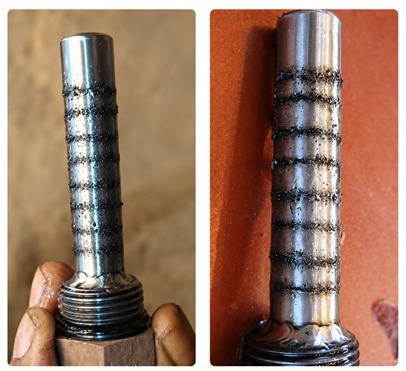
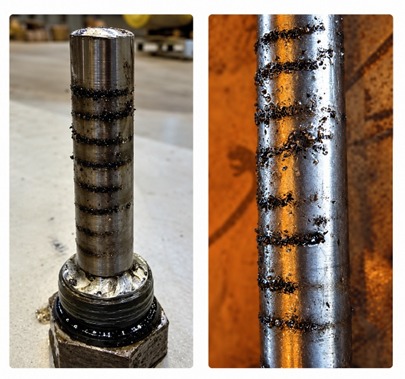
left-hand-side front wheel hub / right-hand-side front wheel hub]
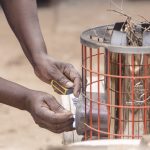
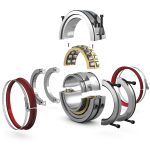
At an iron ore mine in Kathu, South Africa, a 92-truck fleet of Komatsu 860E and 960E haul trucks was experiencing 1 to 3 premature front wheel hub bearing failures per week, at a reported cost of R1 million per failure. The expected hub life was 20,000 hours. In November 2016, the mine’s reliability team replaced the OEM plugs with OEI Magnetic Filter Elements on a trial fleet. Over the following 10 weeks, there were zero front wheel hub failures.
The mine subsequently outfitted the front wheel hubs across all 92 haul trucks. Over the two-year pilot period, 208 bearing failures were prevented based on the site’s previous failure rate, representing R208 million in avoided failure costs. The results led the mine to expand OEI filtration to other critical haul truck systems, including engines, hydraulics, coolant and lube oil, and to consider wider deployment across the organization’s international operations.
The Broader Picture
The Kathu case is not an anomaly. It is a demonstration of what happens when the particle population that cleanliness standards cannot count, and conventional filtration is challenged to remove, is finally addressed. The same sub-micron wear mechanism operates in every lubricated system across a mine. The same blind zone exists in every ISO particle count and PQ reading being used to manage those systems.
From Contamination Control to Equipment Protection
At LPR Group, contamination control is part of a broader discipline spanning lubricant selection, proactive maintenance, equipment protection and asset reliability. With more than 25 years of experience in lubrication and engineering solutions, LPR understands that there is no single solution to equipment reliability. The right approach starts with understanding the application, operating environment and risks.
The cost of contamination is not necessarily found in the price of a filter or lubricant. The bigger consideration is what contamination can mean for equipment performance, maintenance requirements, component life, and overall operational reliability. For this reason, contamination control deserves to be considered as part of a proactive reliability strategy rather than simply another maintenance task.
Contamination control therefore deserves to be considered part of a proactive reliability strategy rather than simply another maintenance task.
Rather than recommending a solution in isolation, LPR’s approach is to understand the customer’s specific application and identify where improvements can be made. The first step is understanding the condition of the system and identifying where contamination may be entering, circulating, or creating risk.
Together with OEI, LPR can provide filtration technology designed to address contamination at the sub-micron level, helping operations across mining, power generation, processing and heavy industry take a closer look at one of the smallest factors influencing equipment reliability.
Speak to LPR Group about a Contamination Assessment.
Scan QR code – Landing page to LPR website
