






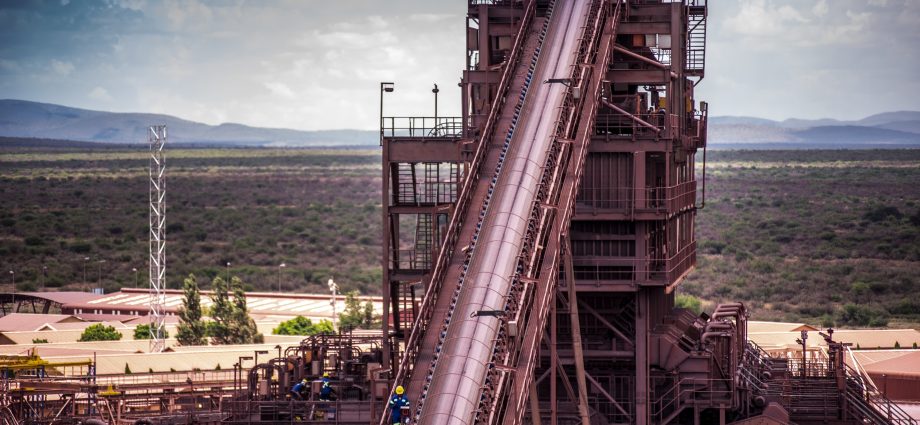
Materials transfer systems sit at the heart of every minerals processing operation, quietly moving thousands of tonnes of ore every hour between crushers, screens, conveyors and processing equipment. Yet despite their importance, transfer systems are frequently approached as isolated equipment purchases rather than strategic engineering assets that influence the performance of the entire plant.
Dewald Tintinger, Technical Director at Weba Chute Systems, says that this mindset often prevents operations from achieving the best long-term outcomes.
“Transfer systems should never be viewed simply as products,” Tintinger says. “They are engineered components within a much larger materials handling system and their performance affects everything from plant availability and maintenance costs to dust control, safety and energy consumption.”
He explains that many operational challenges attributed to transfer chutes are, in fact, symptoms of broader materials flow issues.
Poor flow characteristics, excessive wear, belt mistracking, blockages, spillage and dust generation are often interconnected, meaning that replacing one component without understanding the overall transfer process rarely delivers a sustainable solution.
“The first question should never be ‘Which chute should we install?’,” he says. “The first question should always be ‘What is causing the problem?’”
Answering that question requires a detailed understanding of material behaviour, operating conditions and the interaction between multiple pieces of equipment throughout the processing circuit.
“Every ore behaves differently,” Tintinger explains. “Particle size, moisture content, fragmentation, throughput variability and wear characteristics all influence how material flows through a plant. Unless those variables are understood it becomes very easy to treat symptoms instead of addressing the root cause.”
This is where the relationship between an OEM and its customer becomes critical. Tintinger believes mines and minerals processing plant derive significantly greater value from partners whose objective is improving plant performance rather than simply supplying equipment.
“Sometimes the solution is considerably simpler than originally envisaged,” he says. “A modification to transfer geometry, a change in material flow or adjustments to an existing installation may resolve the issue without requiring a completely new chute. Those are conversations that only happen when the relationship is built on trust and engineering integrity.”
Conversely, when success is measured primarily by product sales, opportunities for simpler and more cost effective solutions can easily be overlooked.
“The best engineering recommendation is not always the one that results in the largest equipment order,” Tintinger says. “It is the one that delivers the greatest long-term operational benefit.”
This philosophy underpins Weba Chute Systems’ approach to customer engagement. Rather than viewing projects as standalone equipment installations, the company works with mines and minerals processing plants throughout the lifecycle of their operations, recognising that transfer requirements evolve as ore bodies change, production targets increase and plants undergo expansion or optimisation.
“Very few processing plants operate exactly as they did when they were commissioned,” Tintinger says. “Throughput changes, ore characteristics evolve, equipment is upgraded and production priorities shift. Transfer systems need to evolve alongside those changes.”
Ongoing collaboration allows transfer performance to be continuously reviewed and refined, enabling incremental improvements that reduce maintenance, extend equipment life and improve operational reliability.
“The value of a long-term partnership is that knowledge accumulates over time,” he explains. “As we develop a deeper understanding of a customer’s operation, we are better positioned to identify opportunities that improve performance, often before problems begin affecting production.”
With many mining companies focusing on extracting greater value from existing assets rather than investing in new processing facilities, Tintinger believes this lifecycle approach is becoming increasingly important.
“The industry is looking for sustainable productivity improvements,” he says. “That requires engineering partners who understand the complete material transfer process, challenge assumptions where necessary and recommend solutions based on operational performance rather than equipment sales.”
Tintinger concludes that successful transfer systems are ultimately measured not by the equipment installed, but by the long-term value they create.
“When mines collaborate with OEMs that are invested in the performance of the operation over its entire lifecycle, they gain much more than transfer equipment,” he concludes. “They gain an engineering partner committed to continuously improving the efficiency, reliability and sustainability of the complete materials handling process.”
