









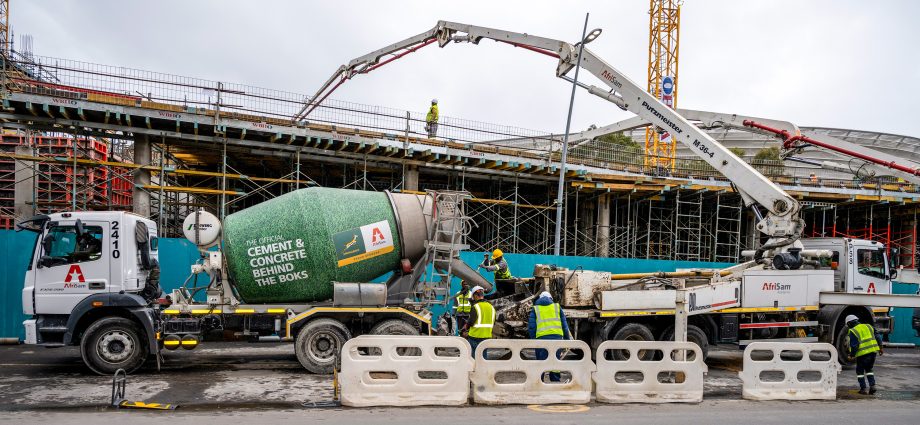
As pressure grows on the South African construction industry to demonstrate measurable progress on sustainability, AfriSam is taking low-carbon concrete a step further with its Carbon Wise™ range of readymix solutions.
The initiative combines established approaches to reducing embodied carbon with a new focus on quantifying the carbon footprint of individual concrete mixes – giving engineers, developers and contractors a more accurate basis for material selection. According to Amit Dawneerangen, Construction Materials Sales & Product Technical Executive at AfriSam, the initiative is an industry-leading development in the way concrete is specified.
“Carbon Wise allows us to provide customers with the carbon footprint of every concrete mix in AfriSam’s mix portfolio ,” Dawneerangen says. “This makes it simpler for specifiers to consider carbon footprint alongside the other performance characteristics of the concrete in each project.”
The immediate market driver for this innovation has been the growing emphasis on green building requirements, explains Nithia Pillay, Regional Product Technical Manager Construction Materials at AfriSam.
“Green building specifications have increasingly called for partial replacement of ordinary Portland cement (OPC) with supplementary cementitious materials, as well as the use of recycled aggregates,” Pillay says. “Carbon tax is also contributing to the wider focus on reducing emissions, although this has historically been more directly associated with cement.”
Carbon Wise™ now makes the carbon contribution of concrete itself more transparent, he points out. AfriSam calculates the carbon equivalent associated with each specific mix using a measurement tool originally developed by the Cement and Concrete Institute of South Africa, with constituent-material values covering cement, extenders, aggregates, admixtures, water and the operation of the readymix plant.
Pillay notes that AfriSam has deliberately adopted conservative local industry values rather than relying on international data that could produce lower calculated emissions. This approach provides scope to refine the methodology as South African industry data develops.
“Crucially, lower embodied carbon does not mean lower performance of the concrete mixes,” he emphasises. “We have extensive experience with supplementary cementitious materials (SCMs), and our approach is to optimise mixes for the particular requirements of each application.”
This has underpinned AfriSam’s ability to engineer concrete mixes with high levels of SCMs which meet customers’ demanding standards of early strength, workability, pumpability and long-term durability. A recent example is the Main Reef Water Reservoir west of Johannesburg, where up to 60% SCM content was prescribed – partly to enhance durability. AfriSam’s mix achieved the required strength at 28 days despite a specification requiring target strength achievement at 56 days.
The current Carbon Wise™ offering comprises three categories, says Dawneerangen. The Rapid mix delivers a measured 18% reduction in carbon emissions against an equivalent OPC reference mix. Enhanced mixes, with up to about 40% total SCM content, achieve a 28% reduction, while the Eco mix includes about 60% total SCM content and achieves a 44% reduction. AfriSam is also developing a further range capable of achieving a 50% reduction in carbon emissions.
“Our scientific approach means that we can support the market in moving beyond broad sustainability claims towards a specific, measurable contribution from concrete,” he says. “With Carbon Wise, customers are provided the specific carbon equivalent value relative to concrete offtake demonstrating the reduction in carbon footprint.”
This breakthrough highlights the importance of collaboration between the concrete producer, engineer, contractor and developer, says Pillay. Different Carbon Wise™ mixes offer varying levels of carbon reduction and are suited to specific applications, making early engagement important in selecting the appropriate solution.
“Beyond embodied carbon, the approach can support longer-term project performance,” Pillay explains. “Mixes containing SCMs can also create a denser concrete matrix, for instance, thus reducing porosity and helping to improve durability when combined with appropriate compaction and curing.”
Dawneerangen says that Carbon Wise™ will ultimately make carbon reduction easier to incorporate into mainstream concrete specification.
“By accurately measuring the carbon content of concrete mixes, this innovative range will help support the contribution that concrete makes towards sustainability,” he concludes. “This aligns with AfriSam’s long-established commitment to the future of our planet.”
