







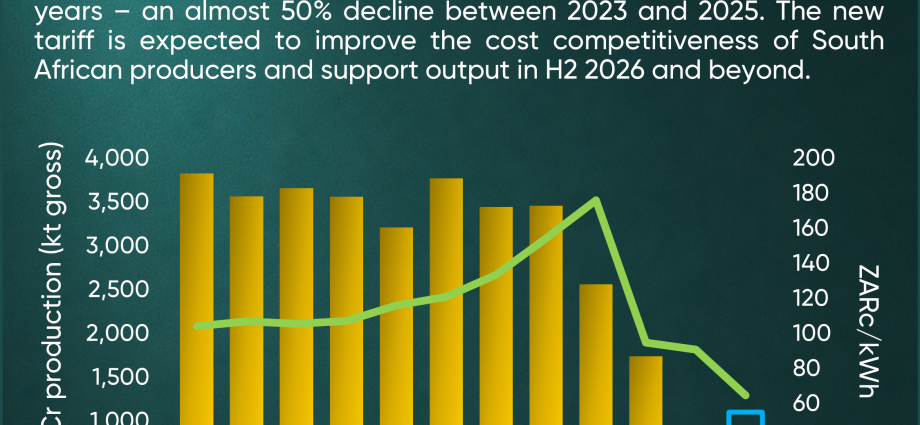
The approval of Eskom’s ZAR62c/kWh (US$0.038/kWh) tariff for energy-intensive users marks a significant milestone for South Africa’s ferrochrome industry. Whilst the tariff alone is unlikely to reverse two decades of structural decline, it may help stabilise the sector and preserve the country’s remaining competitive smelting capacity.
South Africa entered the 2000s as the world’s leading ferrochrome producer, supported by abundant chromite resources, low-cost electricity and a growing smelting industry. This led to significant capacity expansions across the sector, including the development of large-scale ferrochrome operations by Samancor, Xstrata, Hernic, and Assmang. However, the industry’s competitive position began to deteriorate after the 2008 electricity crisis. Eskom’s tariffs rose sharply over the following decade, eroding one of the industry’s historical advantages and placing increasing pressure on electricity-intensive smelting operations.
This was compounded by weaker global stainless steel demand during the 2015-2016 economic slowdown and by the continued expansion of China’s ferrochrome and stainless steel industries, supported by imports of South African chrome ore. During this period, the South African ferrochrome industry consolidated, with assets increasingly concentrated within Samancor and Glencore-Merafe (formerly Xstrata). While the depreciation of the rand provided some protection by lowering US dollar-denominated production costs, this benefit was gradually outweighed by rising domestic operating costs, an unreliable electricity supply, and increasing maintenance requirements associated with load curtailment and operational interruptions.
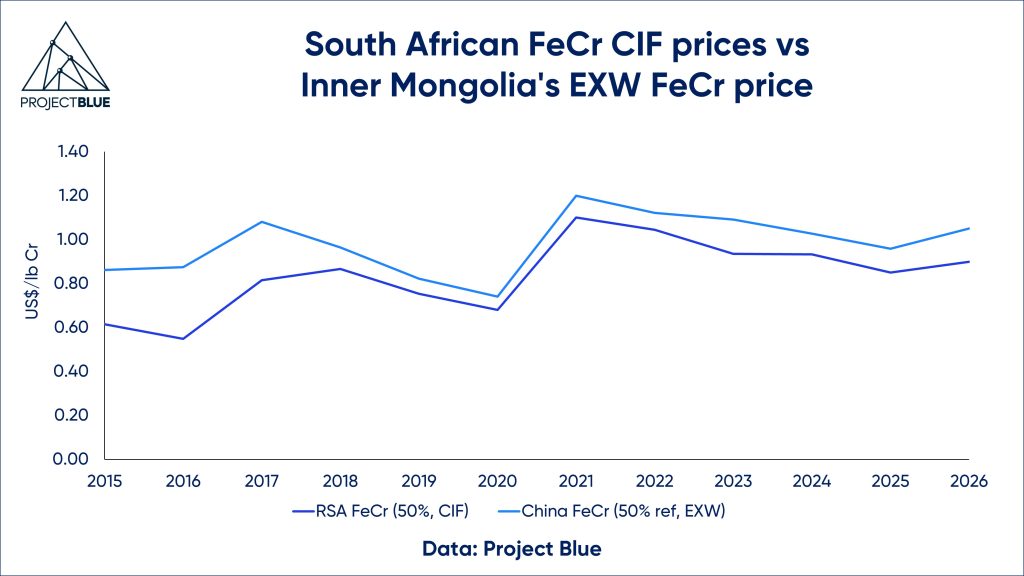
Simultaneously, China rapidly expanded its ferrochrome smelting capacity. Although China possesses limited domestic chromite resources and remains heavily dependent on imported ore, it has developed a large integrated ferrochrome and stainless steel industry. Today, South African ferrochrome often trades at a discount to Chinese domestic ferrochrome despite being produced closer to the ore source. This reflects both China’s scale and the cost pressures facing South African producers.
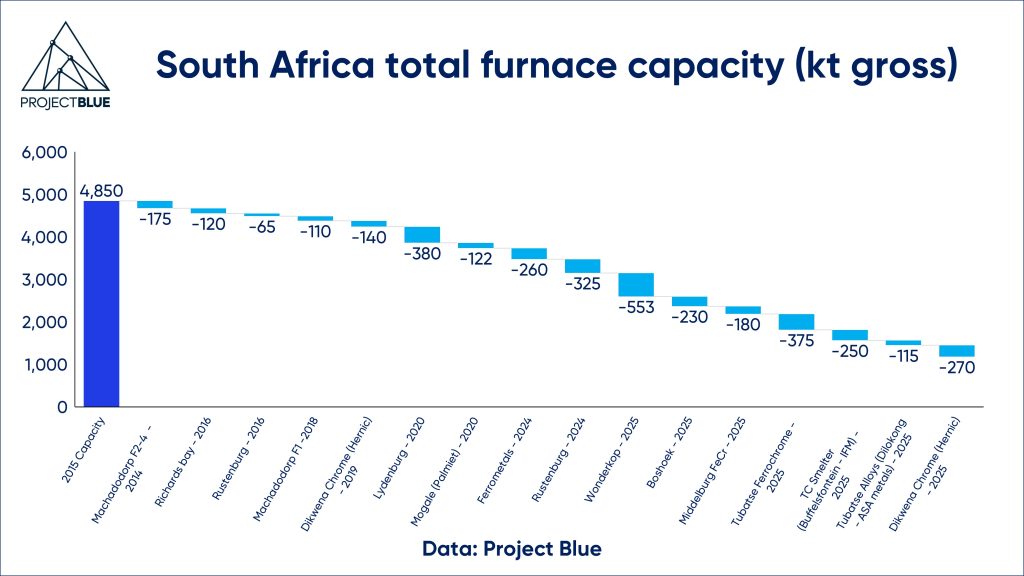
The ZAR62c/kWh tariff is therefore an important intervention. First, it provides Eskom with a stable source of baseload demand from large industrial consumers. Second, it improves the competitiveness of South African ferrochrome producers relative to international peers. South Africa remains one of the few regions capable of producing large volumes of 50-52% charge chrome, a key feedstock for the global stainless steel industry. Lower electricity costs may improve the viability of existing operations and support the restart of selected furnaces currently on care and maintenance.
However, the tariff should not be viewed as a complete solution. Several smelters have been idle for years and would require significant capital expenditure to restart. Furthermore, global ferrochrome demand may not justify the return of all historical capacity. South Africa has also experienced a prolonged decline in domestic stainless steel production and downstream manufacturing, thereby limiting local demand for ferrochrome and other beneficiated products. Skills retention presents a further challenge, as workforce reductions and Section 189 processes have reduced the pool of experienced personnel available to support future growth.
The approval of the ZAR62c/kWh tariff also implicitly acknowledges a reality often overlooked in South Africa’s beneficiation debate: the country cannot economically beneficiate all its chrome ore domestically. Even under a lower electricity tariff, South Africa lacks sufficient operational smelting capacity to process all chrome ore currently exported, whilst several idled furnaces would require substantial capital investment to restart.
This has important implications for policy discussions around chrome ore export restrictions or export bans. While increasing domestic beneficiation remains a desirable objective, such policies are most effective when sufficient competitive smelting capacity exists to absorb additional ore supply. Given current capacity constraints, the impact of export restrictions on ferrochrome production would likely depend on the extent to which idled capacity can be recommissioned and operated competitively.
Policy responses will ultimately depend on broader industrial development objectives and the extent to which ferrochrome production can remain internationally competitive. Measures such as preferential electricity tariffs, infrastructure improvements, or incentives linked to domestic beneficiation may help retain smelting capacity, but their effectiveness will depend on market conditions, investment levels and long-term demand for ferrochrome. While increasing domestic beneficiation remains a policy objective, practical constraints on smelting capacity suggest that South Africa’s chrome industry is likely to continue relying on a combination of ore exports and ferrochrome production.
For those looking to explore the outlook for ferrochrome and the wider ferroalloys market in greater depth, these topics will be discussed further at the Critical Materials Conference: Ferroalloys 2026, taking place from 8-9 September, in Johannesburg.
Find out more and secure your place: https://www.projectblue.com/events/41/critical-materials-conference:-ferroalloys-2026
About Project Blue:
Project Blue is a leading, global provider of market intelligence for more than 50 critical material supply chains.
- Aerospace & Defence
- EV & Battery
- Semiconductors & Electronics
- Steel & Alloy
- Solar, Wind & ESS
We are trusted by organisations across industry, finance and government, to provide accurate data and analytics which enable strategic and investment decision-making.
Through regular market analysis and forecasts, bespoke consultancy services and global events, we support market participants across our industries with their operations.
Learn more at www.projectblue.com.
